
The Fire That Never Caught
Prevention works best when it leaves nothing behind — which is exactly why no one rewards it.

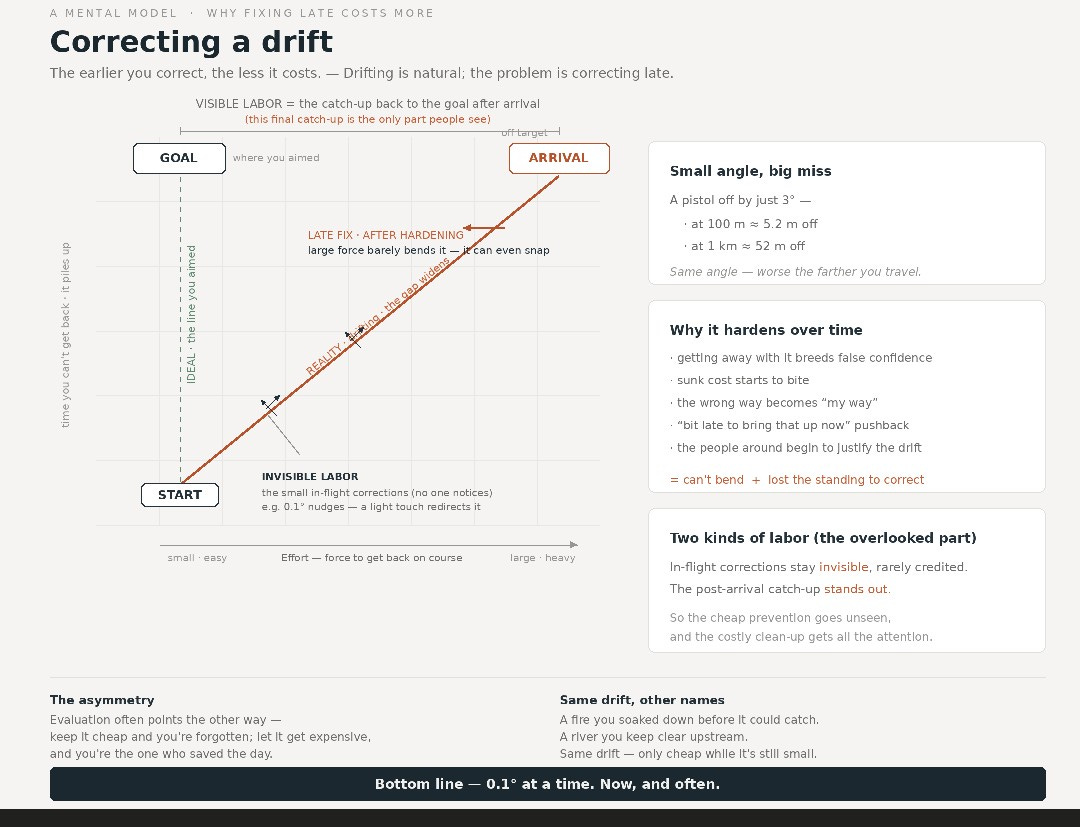
Every company has two kinds of people who can fix things.
One kind fixes things after something big has gone wrong. The system you delivered goes down. A complaint flares up. The floor stops running. They rush in and sort it out, and everyone watches them do it. "Thank god they were here," people say. The incident comes up in the performance review. It gets retold around the office.
The other kind fixes things before anything goes wrong. They catch a small contradiction in the spec early and quietly patch it. They add a word while a new hire is still getting the phrasing wrong. They loosen the tension in a room before it turns into a fight. So sometimes nothing happens at all. Because it never became an incident or a complaint, it never even reaches a meeting agenda. And to everyone around them, this person doesn't even register as "someone who solves problems."
The second kind costs less — less effort, less time. A deviation, caught early and small, takes only a light touch to correct. Leave it, let it bend far enough, and putting it back takes many times the force.
A tiny error in your angle at the start, and the farther you travel the more wildly off you end up. Caught early it's a centimeter; left late it's a meter. But evaluation often points the other way. The person who kept it cheap gets less credit; the person who let it get expensive gets more. Sometimes the effort and the credit flow in opposite directions — the force it took to fix something and the trust you earn for it end up facing away from each other.
It comes down to what the effort leaves behind. Put out a fire and there's a mark where it burned. The smell of smoke, the scorched wall, the time everything stopped — all of it stays. So everyone can see that that person put it out. But the work of someone who soaked things down ahead of time, so they'd never catch, leaves nothing. A fire that never caught is treated as if it was never there.
The irony is that the better prevention works, the harder it gets to see what was even done — because the result only ever shows up in the shape of "nothing happened." And what might have happened is something each person pictures very differently.
There are stages to how early you notice. Some people catch it while it's still a wisp of smoke; some only once smoke is pouring out; some not until it's a full fire. And here's the strange part — the earlier you catch it, the more it looks to everyone else like "that was nothing." You prevented it well, and you get treated as if it was minor. Worse, you can't even be sure yourself. There's no way to confirm whether that smoke really would have become a fire if you'd left it, or whether it would have settled on its own. Or — before any of that — whether it was even a real spark. Maybe you just mistook something harmless for danger and jumped. That doubt can hold back the next move, too, so you won't get pushed out by the people around you. Someone who moves early will, by that same token, sometimes get it wrong. So when someone tells you "you're overthinking it," you can't even prove that's off the mark. You prevented something and still can't hold your head up — you just quietly go looking for the next wisp of smoke.
The prevention side carries one more disadvantage. At the early point, when it's easiest to fix, nothing has gone wrong yet. So when you say "this is dangerous," you have no evidence. "Looks fine to me." "You're overthinking it." It gets waved off. The earlier you try to move, the more you look like someone making a fuss. Prevent it well and no one notices; raise your voice to prevent it and you're called a worrier. You lose twice.
Except — that label, "worrier," only lands on the side without power. The exact same "this is dangerous," said by the CEO, and no one calls it worrying. One word from the top and something gets done on the spot. The difference isn't whether you noticed. It's whether you're on the side that gets believed. What's punished isn't noticing early — it's noticing early without power.
It gets clearer if you think about a waterway, a river. There's an upstream and a downstream. (What you picture as the upstream of that river is up to you.) Only someone who knows the original color can tell the water has changed. The upstream person, who looks at the usual water every day, notices even a faint cloudiness — "this might not be normal." The downstream person doesn't know what color the water was to begin with, so they notice not by color but as a symptom: "something tastes off." The one who can catch the change early is the one holding a baseline — the original state. It's only when downstream runs purple that the upstream person becomes sure something's wrong.
The person who gets the report downstream, learns the water turned purple, traces it back and stops it — they get proper credit. Because there's evidence everyone can see: the cloudiness. But what happens when the upstream person finds the cause early and removes it? Not a single drop of purple water reaches downstream; the river stays clear the whole time. No one knows there was a cause there, that there was even a problem. So their contribution is invisible, and as far as anyone can tell, the problem never existed. The person standing where it's easiest to fix is the person least seen. Depending on the case, they become someone who did nothing.
A river is one stream at the source and branches as it goes down. So trying to deal with the same problem downstream means going around and killing it separately at each of the branches it split into — chasing the same cloudiness in several places. What one push at the source would have handled multiplies into a pile of work. And, ironically, it's the running-around that looks like work. The one push at the source happens once, and no one sees it.
On top of that, upstream work is hard to see from downstream. To the people below, it's not clear what the person above is doing. Kill the problem at the source and, from downstream, it looks like nothing changed. Sometimes there are tangled reasons you can't even say "this is what I'm working on right now." So from below it often looks like this — maybe that person isn't doing anything. The same invisibility runs both ways: from the side evaluating, and from the side looking up.
And when the fix comes late, it doesn't just stand out more — it gets harder to fix. A deviation hardens over time. Because things happened to keep running, you bank a little success and pick up a strange confidence. The effort and time already poured in start to feel too precious to walk away from. The wrong way of doing things quietly becomes "my way," part of who you are. The people around you start operating on that assumption too — "this is how we've done it." "This is how we've done it" piles up, a climate forms, and sometimes it gets passed off as culture. Get that far and say "this part is off," and what comes back is "bit late to bring that up now." Once it's hardened, it won't move, in two senses. Push on it physically and it won't bend. And the standing of the person trying to fix it has quietly thinned, too.
Here's the most twisted part of the mechanism. That "big force" is exactly what looks like achievement to everyone watching. They moved a hard situation by sheer force and settled it. That's easy to see, and on the spot it does look solved. But trace that difficulty back and it came from no one fixing it early. Fixed early, a light push might have done it — and that light push is something no one sees. So the organization hands the credit to the work of fixing things late and large. The thing that made it hard was no one fixing it early, but the neglect itself becomes no one's responsibility, ripening out of sight.
The company's machinery has a hard time picking this up. You can't write "an incident that didn't happen" into a performance review. You can't say "I prevented three, so those three don't exist." What ends up on paper is what happened, and who fixed it. That's all.
So even with no ill intent, a manager can only evaluate what they can see. And the whole organization, without anyone intending it, slides its center of gravity toward starting work only once a problem has surfaced. The firefighter gets promoted; the person who never let a fire start gets evaluated as "someone who didn't really do anything."
"Whoever notices should do it." "Let whoever can, do it." Reasonable-sounding lines you hear all the time. But this logic pushes all the invisible work toward the people who can notice and the people who can do. The more you notice, the more you can, the more you carry. So at work it always lands on "it's always the same people doing it, isn't it."
No one ordered it. It's just that the ability to notice early has become the address the burden gets sent to. And because that burden is invisible, the organization doesn't even realize it's piling up on a specific few.
And this is what works the most quietly. The more it gets pushed onto someone, the more they wear down. Move early, and keep getting "you're overthinking it," "it's nothing" back, and eventually a person learns: maybe noticing early gets me nowhere. So they stop saying it. They notice, and let it pass anyway. What's lost isn't one person's motivation — it's the organization's own ability to notice early. The upstream watch it needs most steps down from its post, one person at a time, quietly.
To the company, a person who's stepped down goes by another name: unmotivated. They didn't start out without motivation. Some of them ran on nothing but the pride they'd staked their name on, getting shaved down each time they moved early, and only got called that once the pride ran out.
You can't run on pride alone. So "just take pride in your work" can't be what the organization counts on to plug this hole, either. The organization turns the person who moved earliest into the person who moves least, and blames the change on their character. It eats its own seed grain with its own hands.
So what the organization is helped by most is the work that's least visible — the person keeping a river clear, unknown to anyone. That value exists only in the form of "nothing happened," a form there's no way to evaluate.
This isn't a story about feeling sorry for someone upstream. Feel sorry for them all you like and the work stays just as invisible. I don't know a good way to do this yet myself, because the bud of a problem I saw and the bud someone else saw bloom into different flowers. Whoever's reading this is standing downstream of some river that someone, somewhere you'll never know, has kept clear for you — going about your day with a straight face on top of things that were fixed before you noticed. Me too, without a doubt.
So the real difficulty starts here. How do you see what didn't happen? How do you count the times you were helped without knowing? How do you properly evaluate someone who takes on improvement on their own? I'll be straight: I don't have that answer yet. Only — someone is always standing just before that clear, untouched river. That much, at least, I'd rather not forget.
Arimitsu,
Perfect title. You took the mechanism and made it breathe.
Three concepts earned their keep. First, the two-direction invisibility. From above, evaluating. From below, looking up. I am not sure if people see this. You explained both, and the second is the harder one to write about.
Second, the stepping down. The noticer who learns that noticing gets them nowhere, and quietly takes their hand off the post. The organization renames that person "unmotivated" without ever knowing what it lost. I will print that and hang it in my office.
Third, "eats its own seed grain with its own hands." That is deep. Once you read it, you cannot pretend the harm is external.
The question you closed on — how do you see what did not happen — has a partial answer. You make the non-event attributable. A decision log. A pinned definition. A dated counterfactual debrief. None of it counts the way a fire counts. It leaves a trail future-us can find, and that may be the only way the upstream post stops being structurally empty.
The clear, untouched river. We'll done.